In short: sewing corduroy goes well on three conditions. You find the nap direction before anything else and cut every piece the same way up, otherwise the panels won't be the same shade. You stitch with a long stitch and a presser foot that doesn't press down too hard, so the two layers don't creep over each other. And you press on the wrong side, without pushing down, so you don't flatten the ribs. The rest is the know-how of an ordinary woven fabric: corduroy is cut, sewn and hemmed like a cotton, with a little more care.
What is corduroy?
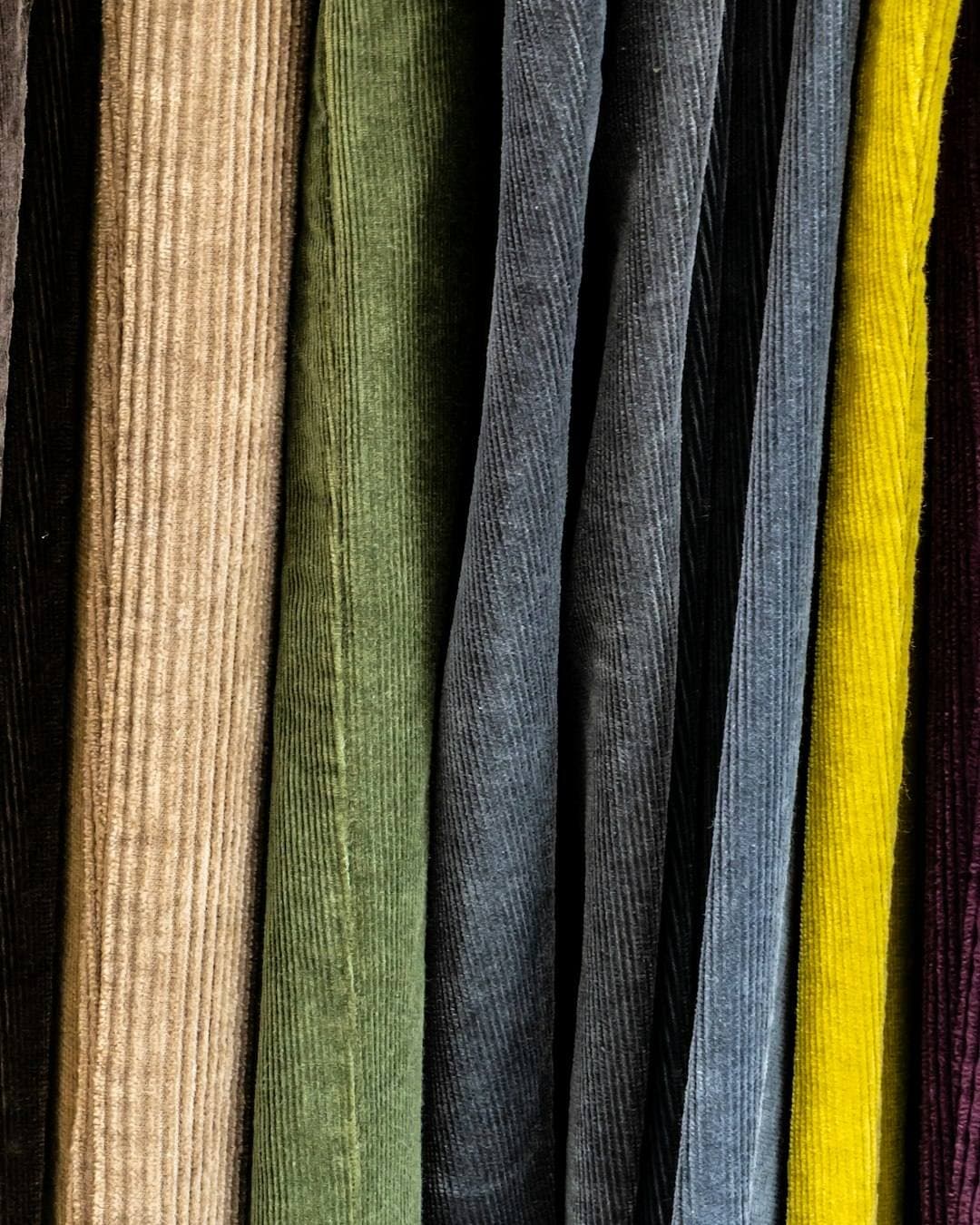
It is a fabric, most often cotton, whose right side carries parallel ribs of pile (the wales), separated by fine lines with no pile. The wales run along the warp, so parallel to the selvedges. Corduroy is mostly classified by how fine its wales are, expressed as the number of "lines" per metre of width.
| Name | Wales | Look | Common uses |
|---|---|---|---|
| Needlecord (fine-wale) | about 1,000 lines per metre | very fine, almost smooth | shirt, blouse, children's clothes |
| Standard corduroy | about 500 lines per metre | clear ribs, medium pile | trousers, skirt, jacket |
| Jumbo cord (wide-wale) | well under 500 lines per metre | wide ribs, thick | jacket, coat, upholstery |
The first two figures are the ones used by fabric manufacturers and sellers. For a first project, standard corduroy is the easiest: thick enough to hold its shape, supple enough to go under the presser foot.
Ready to go from reading to sewing? The verdict on your photo costs you nothing: you only pay when you order the pattern.
Create my made-to-measure patternHow do you find the corduroy nap direction?
Run your hand flat over the right side, along the length. In one direction the pile lies down: the surface looks lighter and shinier. In the other it stands up: it looks darker and keeps the mark of your hand. Mark the direction on the wrong side with a chalk arrow, roughly every fifty centimetres.
Both directions work, but you have to choose one for the whole garment:
- nap up (stroking downwards goes against the pile): the colour is deeper and richer, the most common choice for trousers or a skirt;
- nap down: the surface is lighter and shinier, and wears a little less quickly.
How do you cut corduroy?
Every piece is laid top towards the same end, with the grainline arrow parallel to the wales. This uses more fabric: our guide to how much fabric you need allows 10 to 20% extra for a fabric with a nap.
- Cut in a single layer whenever you can, right side down. Folded right sides together, the pile grips and the two layers shift; your symmetrical pieces would no longer be symmetrical.
- Flip the pattern piece over for the second piece of a pair, without ever turning it top to bottom.
- Line up the wales at the centre front and centre back: a wale that wanders off at an angle shows from a distance.
- Pin in the seam allowances only. On a dense pile, a pin leaves a mark that takes a while to disappear.
To check that the pattern is laid correctly, our article on cutting fabric on the grain gives the ruler-and-selvedge method.
Which machine settings for sewing corduroy?
The typical problem with corduroy is that the two layers feed at different speeds: the pile of the top layer is pushed by the presser foot, while the bottom layer is pulled by the feed dogs. By the end of the seam, one piece overhangs the other by several millimetres.
The settings that limit this creeping, common studio guidelines to confirm on a scrap:
| Setting | Guideline | Why |
|---|---|---|
| Needle | universal 80 to 90 (100 for jumbo cord) | goes through the thickness without crushing it |
| Stitch length | about 3 mm | a short stitch packs down the pile and puckers the seam |
| Presser foot pressure | reduced, if your machine allows it | the foot pushes the top layer less |
| Presser foot | walking foot, if you have one | feeds both layers together |
Without a special foot, tack the long seams (side seams, inside leg) or pin very closely, at right angles to the seam, and sew in the direction of the nap. For choosing needles in general, see which needle and thread to sew with.
How to press corduroy without crushing it
An iron laid flat on the right side flattens the wales and leaves a shiny mark, sometimes for good. The rules:
- Always on the wrong side, never on the right side.
- Lay the right side on a thick towel or a scrap of corduroy, pile to pile: the wales sink into it instead of being crushed.
- Steam, little pressure: bring the iron close, release the steam, barely touch. To open a seam, your fingers are often enough once the fabric is warm.
- Set the temperature for the fibre: a cotton corduroy takes the cotton setting; a corduroy blended with synthetics needs less. Test on a scrap. Our guide to pressing in sewing gives the temperatures fibre by fibre.
Which seam finishes for corduroy?
Cotton corduroy frays moderately. A zigzag or overlocking on each seam allowance is enough; for a clean inside, French seams work on needlecord, but they are too bulky on jumbo cord. To reduce bulk where seams cross (crotch, waistband), grade the seam allowances: trim one narrower than the other. If you don't have an overlocker, our guide to neatening seams without an overlocker explains each stitch.
When it comes to care, wash the garment inside out: the pile rubs less against the drum and goes pale less quickly.
Frequently asked questions about corduroy
Which way do you cut corduroy?
Every piece the same way up, grainline parallel to the wales. Nap up gives a deeper colour, nap down a lighter surface; what matters is that the whole garment follows the same direction.
Should you wash corduroy before sewing it?
Yes, like any cotton: cotton corduroy can shrink in the first wash. Wash the length of fabric inside out, on the programme given on its label, and dry it flat before cutting.
What stitch length for corduroy?
Around 3 mm for standard corduroy. A stitch that is too short packs down the pile and makes the seam ripple; always test on a scrap folded in two.
Why do my two layers shift when I sew?
The presser foot pushes the top layer while the feed dogs pull the bottom one. Reduce the presser foot pressure, lengthen the stitch, tack or pin closely, and use a walking foot if you have one.
Can you press corduroy?
Yes, on the wrong side only, with the right side on a thick towel, using steam and very little pressure. An iron placed on the right side crushes the wales.
Corduroy trousers need a pattern that is right at the hips and the crotch, where the fabric forgives nothing. The studio drafts a trousers pattern to your body measurements, seam allowances included, with its sewing instructions. A toile is still recommended before you cut into the corduroy.
Cover photo: Connie de Vries on Unsplash.