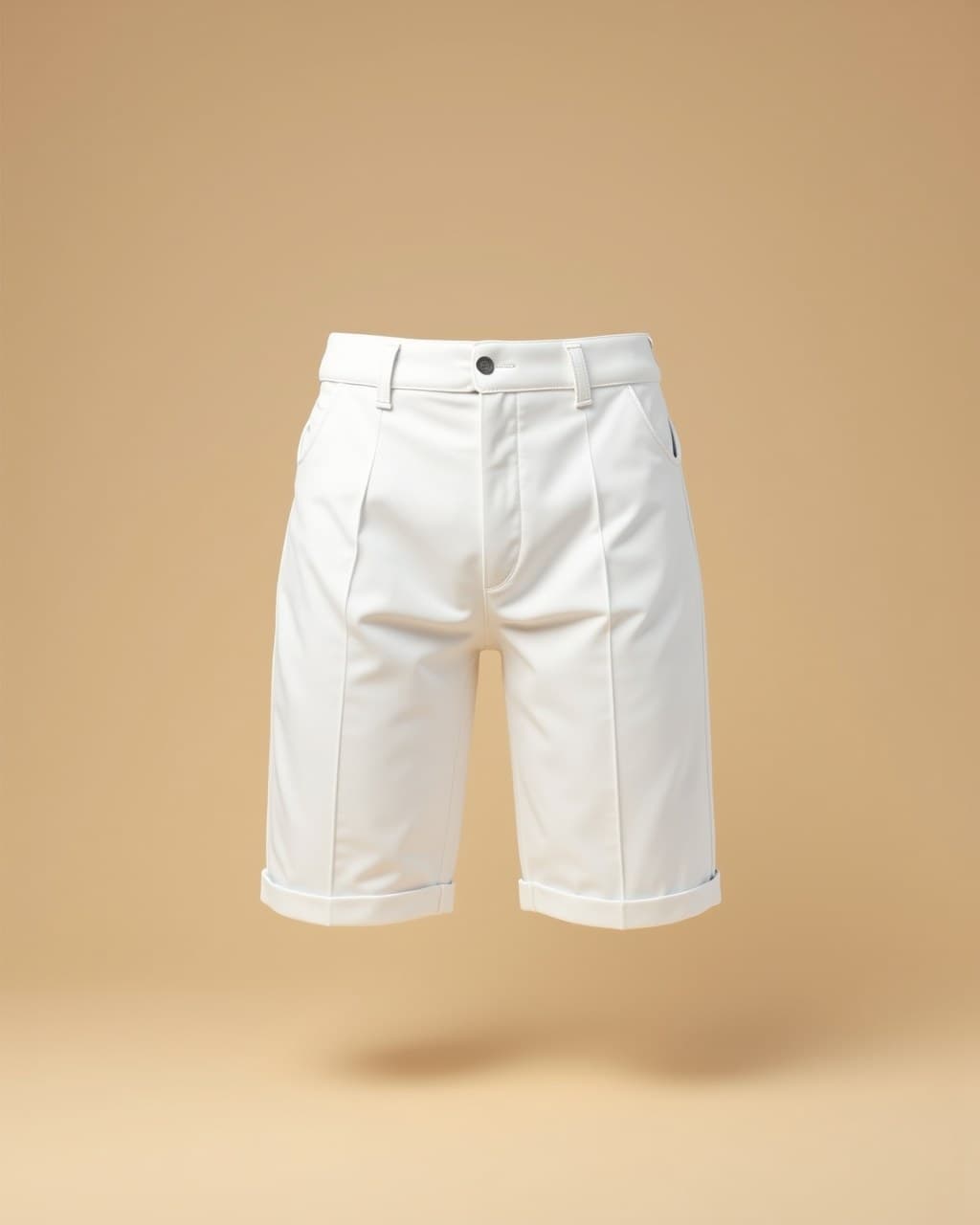
How do you draft a shorts pattern that really fits? A made-to-measure shorts pattern is built from your waist and your hips, combined with a photo of the design that inspires you. Shorts are the quickest garment for the lower body to sew (no long legs to join, no endless hem), but they are also where a single rough measurement shows straight away: the crotch.
In short: the photo gives the style (a pull-on elastic waist or structured shorts with a fly front, a straight or flowing cut, a length above or below the knee) and your body measurements give the dimensions. Shorts that fit are shorts whose crotch sits just right: not pulling when you sit, not sagging between the legs.
Why made-to-measure changes everything for shorts
On a garment for the lower body, the difficulty does not come from the circumferences but from what links them. Three points decide the result:
- Crotch depth. This is the distance between the waistline and the chair. Too short, it pulls and cuts in; too long, it creates that unflattering pouch between the legs. It varies a great deal between people with the same hip measurement: the studio estimates it from your proportions, and the toile confirms it.
- The waist-to-hip difference. Ready-to-wear fixes it at an average. The familiar result: shorts that close at the hips gape at the back waist, or the other way round.
- Length. Shorts are judged to within a few centimetres, and the reference point is taken on you, standing up, not from a chart.
Made-to-measure turns the logic around: it starts from your real figures instead of making you fit into a chart. If you already know the folds that appear on badly fitting trousers, our article on trousers wrinkling at the back shows exactly what the crotch does when it is wrong.
Ready to go from reading to sewing?
Create a pattern to my measurementsWhich style of shorts should you choose?
Elastic-waist shorts
No fastening: the waistband is a casing with elastic threaded through, sometimes with a drawstring as well. It is the most accessible style, the one to start with, and it forgives a slight difference in the waist measurement.
Fly-front shorts
A separate waistband, a zip and a button. These are the classic structured shorts. They are more demanding to make (the fly is a small construction in its own right) but the result has a structure that elastic cannot give. See our step-by-step guide to inserting a classic zip.
Pleated shorts
Pleats laid flat at the front and held in the waistband add room over the hips and thigh while keeping a neat waist. Shops sometimes call them “darted shorts”, but these really are pleats: the fabric is folded at the waist and opens freely lower down, whereas a dart is stitched along its whole length. Elegant and a little more technical: each pleat is marked at the pattern's notches and tacked before the waistband goes on.
Flowing shorts or culottes
Cut wide, they hang like a short skirt while keeping separate legs. Their crotch is deliberately lower and their fullness generous: it is a pattern choice, not a fitting fault.
Pockets
Slant pockets cut into the side seam, patch pockets at the back, welt pockets: they are placed according to the length of the shorts and the height of the waist, two settings that made-to-measure recalculates.
How do you get a shorts pattern from a photo?
- Choose a good photo. Sharp, from the front, of the shorts being worn. A view of the back is especially useful here: the back pocket and the shape of the seat are hard to read from the front.
- Let the studio read the cut. We identify the type of waistband, whether there are darts or pleats, the waist position and the length.
- Enter your measurements. Taken once, they serve again for all your patterns; see taking your measurements for sewing.
- Receive the pattern. Printed at 1:1 scale, seam allowances included, with notches and grainline. The sewing instructions guide you from the crotch seam to attaching the waistband.
- Make a toile. On a garment for the lower body, this is the advice that matters most. A toile in inexpensive cotton checks the crotch before you cut the real fabric.
Depending on the design drafted, the studio offers some adjustments included, or none: your project page tells you which. All the styles are set out on the page for the made-to-measure shorts pattern.
Which measurements do you need for made-to-measure shorts?
- Waist. At the natural waist, where the body bends when you lean to the side.
- Hips. About 13 cm below the waist, level with the points of the hip bones.
- Seat. At the fullest part of the buttocks: this is the measurement that has to pass without strain.
- Waist to hip. The vertical distance between the waist and the hip line.
- Thigh. At the fullest part, for a leg that doesn't grip.
- Desired length. Measured on you, standing, from the waist to where you want the hem.
Commercial pattern or made-to-measure pattern: which to choose?
| Criterion | Commercial pattern (standard size) | Made-to-measure pattern |
|---|---|---|
| Starting point | An average size chart | Your real measurements |
| Crotch depth | Fixed, the same for a whole size | Estimated from your proportions, checked on the toile |
| Waist-to-hip difference | Set by the chart | Exactly yours |
| Thigh | Worked out from the hip measurement | Entered separately |
| Length | Standard, to be altered | Chosen on you |
| Sewing instructions | Varies by pattern company | Included, written for the garment you are sewing |
Which fabric for shorts?
Shorts are most often sewn in a stable woven fabric, which holds its shape and copes with sitting down.
- Cotton gabardine, drill or twill, around 200 to 280 g/m²: the go-to for structured shorts. It cuts straight, doesn't slip and holds a pressed crease.
- Linen or linen-cotton blend: perfect for summer, soft and breathable, with creases you embrace.
- Chambray or lightweight denim: hard-wearing, ideal for fly-front shorts.
- Viscose or lyocell: keep these for flowing shorts, as they slip when cut; see sewing viscose.
For your first pair of shorts, avoid stretch knits unless the design is made specifically for them. Check the fabric width (often 140 or 150 cm): it decides how much fabric to buy, shown on the pattern's cutting layout; see working out how much fabric you need. Crotch seams take a lot of strain, so neaten them carefully: neatening seams without an overlocker gives solutions for a domestic sewing machine.
Shorts are a shortcut to pattern cutting for the lower body. All the difficulty of trousers is already there (the crotch, the waist-to-hip difference, the seat) but concentrated in a little fabric and a little time. Get shorts right and you have already understood trousers.
Got a photo of shorts you love and your measurements? Let the studio turn them into a pattern in your size, ready to print with its sewing instructions. Create my made-to-measure shorts pattern.
FAQ: made-to-measure shorts pattern
Can you start from a photo to make a shorts pattern from your own measurements?
Yes. The photo sets the style: type of waistband, darts or pleats, waist position, length. It does not give the dimensions: your body measurements, entered separately, provide those. A view of the back makes the seat and back pockets much easier to read.
What is the most important measurement for shorts?
Your seat measurement, taken at the fullest part of the buttocks: it has to pass without strain. Comfort, though, comes down to the crotch: too short, the shorts pull and cut in; too long, they sag between the legs. The form does not ask for your crotch depth; the studio estimates it from your proportions, and the toile confirms it before you cut into your good fabric.
Elastic waist or fly front for a beginner?
The elastic waist, without hesitation. A casing and elastic need two straight seams, tolerate a slight difference in measurement and let you tackle the crotch without the added difficulty of a fly. Fly-front shorts make a very good second project.
Should you make a toile for shorts?
Yes, it is the garment where it pays off most. A simple inexpensive cotton is enough: you sew the crotch, side and inside leg seams, try them on standing then sitting, and confirm the depth before you touch your good fabric.
Does the pattern include seam allowances?
Yes, they are included in the draft and marked on each piece, like the grainline and the notches. You print at 1:1 scale, you cut, you sew. See our guide to seam allowances.